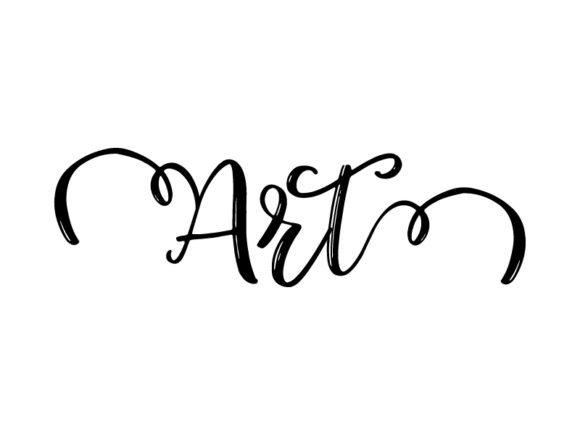
Art Lettering: Bold, Hand-Drawn Vector Typography
Art Lettering isn’t just about spelling words—it’s about giving language texture, rhythm, and presence. At its core, it’s the intentional, expressive shaping of letters by hand—then refined into clean, scalable vector form. Unlike standard fonts, Art Lettering carries gesture, weight variation, and personality: a subtle taper on a serif, an unexpected swell in a curve, or asymmetry that feels human, not algorithmic. That’s why designers, educators, and makers reach for it when they need typography that communicates *attitude*, not just information.
This monochrome vector collection is built for real-world use—not just aesthetics. Every letter, word, and phrase is drawn by hand, then converted to crisp SVG paths. That means you’re not getting flat PNGs or rigid templates. You’re getting editable, resolution-independent shapes you can scale from a business card to a 4’ x 8’ banner without a pixel blur. And because it’s monochrome, recoloring takes seconds—swap black for navy for a corporate look, gold for luxury packaging, or coral for a playful kids’ classroom poster.
Why Hand-Drawn Vector Lettering Fits Real Creative Work
Most stock typography solves one problem: legibility. Art Lettering solves two: legibility *and* distinction. In crowded digital feeds or saturated retail environments, a custom-drawn “Dream Big” or “Create Daily” stands out—not because it’s flashy, but because it feels intentional and grounded. It signals care. That matters whether you’re printing fabric labels for handmade ceramics or designing Instagram story text overlays for a wellness coach.
Because these are vectors—not raster images—you retain full control. In Illustrator or Affinity Designer, you can:
- Adjust individual anchor points to tweak spacing or add a personal flourish
- Apply gradients, textures, or halftone effects without quality loss
- Isolate letters to layer them over photos or illustrations
- Export cleanly for Cricut or Silhouette machines (ideal for vinyl decals on mugs, tote bags, or notebook covers)
Practical Uses Across Audiences and Platforms
Educators and homeschoolers use these letters to build tactile literacy tools: cut-out alphabet sets for sensory bins, printable sight-word cards with visual consistency, or classroom banners that reinforce tone (“Think Kindly”, “Ask Questions”). The monochrome format ensures low-ink printing, and the vector structure lets you resize “S-T-O-P” signs for hallway walls or tiny versions for student name tags—same file, no rework.
Small business owners apply them directly to product storytelling. A coffee roaster adds hand-lettered “Small Batch • Roasted Daily” to bag seals and tasting notes. A boutique stationer layers “Hand Tied • Made in Portland” over kraft paper packaging. Because the lettering is editable, you can match your brand’s secondary color palette without commissioning new artwork—just change the fill and export.
Bloggers and content creators embed these phrases into social graphics with intention. Instead of overlaying generic fonts on Canva templates, drop in “You Belong Here” as a vector shape—then mask it behind a photo, animate individual letters in After Effects, or convert it to a clipping path for textured backgrounds. The result feels cohesive, not pasted-on.
Textile and home décor designers use the scalability to adapt motifs across substrates: a single “Breathe” composition works as embroidery digitizing reference, screen-print stencil outline, or repeat pattern base (rotate, mirror, offset—vectors handle it). No redrawing needed when moving from pillowcase to ceramic coaster design.
Staying Clear, Consistent, and Audience-Appropriate
Great Art Lettering serves its context—not just its creator. Before editing, ask: *Who sees this first? Where? For how long?* A conference banner needs bold, open letterforms readable from 20 feet. A journal cover invites closer inspection—so finer details, like ink bleed suggestions or cross-hatching, earn their place. A children’s sticker sheet benefits from rounded terminals and generous counters (the enclosed spaces inside “o”, “e”, “a”) for clarity at small sizes.
To keep projects organized across uses:
- Name layers meaningfully in Illustrator (e.g., “Main Phrase”, “Drop Shadow”, “Alternate Swash”)
- Save color variants as separate artboards—not separate files—so one .ai document holds black, white, and brand-color versions
- When adapting for print, outline strokes and check overprint settings to avoid registration issues on spot-color jobs
Ideas That Launch Projects—Not Just Inspiration
Try these grounded starting points:
- Classroom routine posters: “Read • Write • Reflect” in three balanced weights—use consistent spacing and baseline alignment so students subconsciously absorb visual rhythm alongside content
- Product launch packaging: Pair minimalist product photography with bold, centered Art Lettering for the tagline—no extra graphics needed. Let the letterforms carry the voice.
- Conference swag: Print “Listen Deeply” on cotton canvas totes—monochrome ensures dye-sublimation or screen-print fidelity, and the hand-drawn quality signals authenticity, not stock imagery
- Book chapter headers: Use a single repeated letterform (like an ornate “C” for “Chapter”) as a visual anchor—scale it large, then reduce opacity to 15% behind body text for subtle continuity
You don’t need calligraphy skills or illustration training to make meaningful use of Art Lettering. What you do need is a clear purpose—and the flexibility to adapt. These vectors give you both: the expressiveness of hand-drawn work, married to the precision of digital production. They’re ready for the classroom whiteboard marker, the boutique gift tag, the podcast cover, or the limited-edition poster run—without compromise.
That’s the quiet power of well-made Art Lettering: it doesn’t shout. It settles in. It earns attention by feeling earned—not generated.